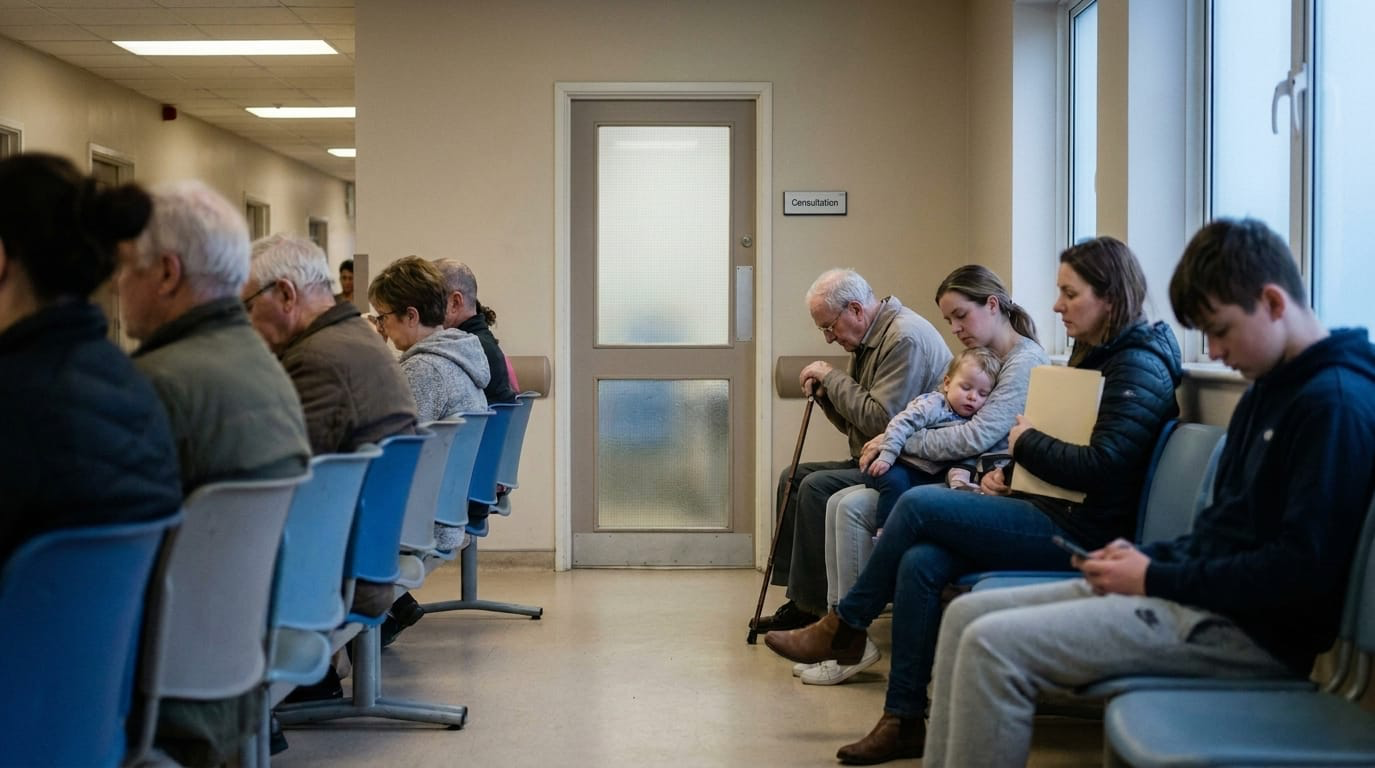
The world is short of doctors. Every major health system is racing to train more. The bottleneck is no longer student numbers. It is the supervised practice required to turn those students into doctors.
If it feels like there aren't enough doctors, it's because there aren't
Across high- and low-income countries alike, getting an appointment with a doctor has quietly become harder. That isn't perception. The World Health Organization estimates the world will be short approximately 11 million health workers by 2030, a figure revised upward from an earlier 10 million projection, with doctors among the worst-affected groups.
The OECD shows the same pattern from a different angle: even as graduate numbers rise, demand rises faster, and most member countries report worsening practitioner-to-population ratios in primary care. A 2022 BMJ Global Health analysisput the specific doctor gap at roughly 4.5 million, benchmarked against universal health coverage targets.
It is now the explicit framing of national workforce plans around the world. There are not enough doctors, and there will be far fewer than needed by 2030 on current trajectories.
Why the doctor shortage is getting worse, not better
The shortage isn't being caused by fewer doctors. What has changed is what we ask of them.
Three forces stack:
- Ageing populations: Across the OECD, the over-65 cohort has grown faster than any other since 2000, and the over-80 cohort fastest of all. Age is the primary risk factor for most health problems that modern medical care addresses.
- Chronic disease load: Diabetes, cardiovascular disease, chronic kidney disease, COPD and rising obesity all need long-term, repeated, relational care, the most clinician-time-intensive kind. Each chronic condition layered on top of the next compounds the time required.
- Mental health: Demand has risen across every age bracket in every market in the last decade, with primary care absorbing most of it.
Per-capita clinician hours have not moved anywhere near as fast as per-capita demand for them. Post-COVID, a chronic shortage tipped into an acute one across most systems simultaneously.
How the world is responding: training more doctors than ever
Every major health system has landed on the same first response: train more doctors. More medical students are enrolled globally than at any point in human history.
The OECD reports that medical graduates rose roughly 75% between 2000 and 2023 across member countries. The country-by-country picture:
- New Zealand: In the past decade or so, New Zealand's medical school intake nearly doubled. Once the University of Waikato opens New Zealand's third medical school in 2028, intake will have risen another roughly 40% in five years on top of that.
- Australia: Domestic medical school commencements have nearly doubled since 2006, with Commonwealth Supported Places scheduled to rise further through the late 2020s.
- United Kingdom: The UK has pledged to roughly double medical student intake by the early 2030s, the largest planned expansion in the NHS's history.
- United States: US medical school total enrolment crossed 100,000 students for the first time in academic year 2025-26, a record cohort across all years and schools combined.
- India: India has approximately doubled the number of medical colleges over the past decade and added a record approximately 11,000 new MBBS seats in the latest admission cycle.
In aggregate, the world is collectively training more doctors than at any point in history, and accelerating.
What this expansion risks
The risk in this plan isn't that it won't work. It is that we solve the doctor-numbers problem and quietly create a doctor-quality problem at the same time, because the way we train doctors has a constraint the way we count them does not.
A medical degree is not delivered the way other degrees are. Most of what makes a competent doctor is learned by doing the work, with feedback, alongside someone who already knows how. That happens on the ward, in clinic, in theatre, in a real consultation room, under the eye of a senior registrar, a consultant, or a clinical tutor.
Those people are drawn from the very workforce the expansion is meant to fix. The shortage of doctors is, by definition, also a shortage of supervisors. Every new cohort needs hospital placements, GP placements, surgical exposure, ward-round teaching, formative feedback, examiner availability, and standardised-patient capacity, all of it provided by clinicians whose first job is patient care, and whose numbers are already stretched.
Placement bottlenecks are now visible in every market. GP placement capacity is a published constraint in the New Zealand business case for the third medical school; UK placement strain is the subject of dedicated policy reports; and Australian medical schools have flagged supervision capacity as the constraint behind their own expansion decisions.
The logic that produced this pipeline plan is sound. The cost of executing it without re-engineering the rest of the system is what isn't yet being talked about plainly.
The real bottleneck: content scales, clinical reasoning doesn't
Parts of medical education scale beautifully. Lectures, recorded videos, textbooks, structured reading, knowledge-recall testing. Modern tools have made these effectively limitless. A first-year student today has more high-quality content available, on demand, than the entire faculty of a medical school had thirty years ago.
But those parts of medical education were never sufficient on their own. They are necessary; they are scaffolding. The thing they are scaffolding for is different in kind. It is the integration of knowledge into clinical reasoning, the messy, probabilistic, patient-specific judgement that distinguishes a doctor from a textbook.
This is the part you cannot read your way into. It is built in the friction of a real encounter, the moment a student commits to an impression, is challenged on it, and has to rebuild their thinking out loud. It depends on someone senior being there to notice the gap between what the student said and what the case actually called for, and to close that gap in real time. That is where students learn how to weigh evidence under uncertainty, how to construct a differential, and how to decide. Clinical gestalt, the rapid, pattern-based judgement experienced clinicians draw on before formal diagnosis, is built one of those encounters at a time.
That is what is at risk as the pipeline scales. Not the content delivery, which scales fine. The supervised practice. The corrected encounter. The teaching moment that requires a senior clinician's attention. As recent guidance in the New England Journal of Medicine has begun to argue, this is now the central problem in how AI is folded into clinical training. Not whether to permit it, but how to supervise its use so that students still acquire the underlying skill.
The literature has a name for the failure mode. Never-skilling is the risk that trainees never acquire a skill in the first place because someone, or something, did it for them. The same shortage that pushed every country to expand intake is the shortage that makes supervision-grade reasoning practice scarce. Training more doctors using the same techniques, more students through the same supervisors, means the part of medical education that actually makes someone a competent doctor is quietly diluted as a side-effect of the pipeline working as planned.
The medical students of 2030 cannot afford to be less prepared than their predecessors. They will inherit a workforce that demands they be better, not worse. That is the question every health system, every medical school, and every educator must now address.